$3 Billion Investment in Hemp-Based Biofuel Production, Power Generation, Diversified Hemp Processing, and Blockchain-Enabled Token Ecosystem in Laos
Executive Summary
Geodyn Solutions is positioned to lead Laos’ green technology sector with a $3 billion USD investment in a vertically integrated hemp ecosystem, enhanced by blockchain technology and a native utility token. This proposal outlines a strategy to cultivate industrial hemp on a large scale for biofuel production, construct biomass power plants to generate electricity from hemp-derived fuels, establish textile and paper manufacturing facilities, and implement a blockchain platform for supply chain transparency and tokenized incentives. Utilizing every part of the hemp plant—seeds for biofuel and oils, fibers for textiles and paper, hurds for paper and construction materials, and residual biomass for energy—creates multiple high-value revenue streams, amplified by blockchain traceability and the Geodyn Token (GEO).
Targeted provinces include Vientiane Province, Savannakhet Province, Bolikhamxai Province, and Champasak Province, selected for their favorable climate, fertile soils, regulatory progress, and agricultural infrastructure. The $3 billion USD budget supports 150,000 acres of hemp cultivation, eight 50 MW power plants, four textile plants, four paper mills, a blockchain infrastructure, and research and development (R&D) for efficiency and innovation. Labor costs are adjusted to Laos’ 2025 average wage of approximately $140 USD/month ($1,680/year) for agricultural and manufacturing workers, reducing operational expenses by 50-70% compared to Western markets.
Financial projections estimate an average ROI of 22-32% over 10 years, with a payback period—the time to recover the $3 billion USD investment through net profits—of approximately 5.0 years, accelerated by low labor costs and incentives. Operational break-even is expected in year three. Blockchain and GEO token integration adds 5-8% to ROI through tokenized carbon credits and ecosystem rewards. The project will create over 8,000 direct jobs and 12,000 indirect jobs, reflecting Laos’ labor-intensive economy, and contribute $3-5 billion USD annually to Laos’ GDP by year five through multipliers in agriculture, manufacturing, energy, and blockchain sectors.
Environmentally, hemp sequesters 10-15 tons of CO2 per acre, regenerates soil, and reduces emissions by 85-97% compared to fossil fuels. Blockchain enables verifiable carbon tracking for global markets. Funding will leverage Laos’ green incentives, World Bank loans, and Asian Development Bank (ADB) support, offsetting 20-30% of costs. This initiative positions Geodyn as a leader in Laos’ bioeconomy, aligning with the country’s 2050 net-zero goals.
Introduction
Laos’ economic growth, with a projected GDP of $17-18 billion USD in 2025, and commitment to sustainable development under the National Socio-Economic Development Plan, create opportunities for renewable investments. Industrial hemp has been approved for controlled activities since 2023 under the Law on Narcotics (2007) amendments, allowing cultivation, processing, and medical use of non-psychoactive hemp varieties. The market is nascent but projected to grow to $300 million USD by 2034 at a 20% CAGR, driven by demand for sustainable products.
This $3 billion USD investment scales to 150,000 acres and facilities. We target Vientiane, Savannakhet, Bolikhamxai, and Champasak Provinces, leveraging agricultural strengths and low labor costs ($140 USD/month or $1,680/year for agriculture/manufacturing). Biomass allocation—35% to textiles, 25% to paper, 25% to biofuel, 15% to energy—optimizes ROI. A blockchain platform with GEO token ensures transparency, compliance with Ministry of Natural Resources and Environment (MoNRE) and Ministry of Industry and Commerce (MoIC), and incentivizes stakeholders. Aligned with incentives from Ministry of Energy and Mines (MEM) and international funding, the project secures subsidies. Diversifying into textiles and paper (global markets at $10-50 billion by 2030) and blockchain enhances profitability and sustainability.
Market Analysis and Opportunity
Laos’ biofuel market is emerging, with biomass potential under the Renewable Energy Development Strategy aiming for 30% renewable energy by 2025. Hemp fits as a sustainable feedstock, reducing reliance on imports. The hemp fiber market could reach $200 million USD by 2033, driven by textiles and packaging. Hemp paper targets global demand, offering faster cycles than trees. Biomass energy qualifies for financial incentives, though no specific FiT; assume $0.08-0.09/kWh based on regional standards. The hemp industry could contribute $1 billion USD to Laos’ economy by 2030. Blockchain in agriculture is growing, with GEO enabling carbon credit trading and certifications.
Low labor costs ($140/month) reduce operational expenses by 50-70% compared to Western markets, boosting competitiveness. Risks like price volatility ($0.40-0.50 USD/lb for biomass) and regulatory hurdles are mitigated through diversification and blockchain transparency. Geodyn’s model, with GEO token utilities, projects $600 million-$1.2 billion USD in annual revenues by year five.
Technology Overview: Hemp Cultivation, Processing, Production, and Blockchain Integration
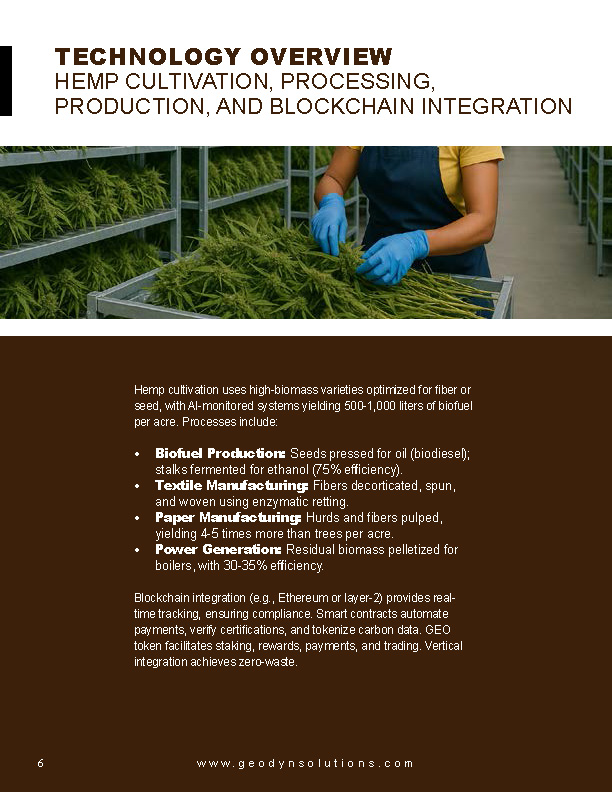
Hemp cultivation uses high-biomass varieties optimized for fiber or seed, with AI-monitored systems yielding 500-1,000 liters of biofuel per acre. Processes include:
- Biofuel Production: Seeds pressed for oil (biodiesel); stalks fermented for ethanol (75% efficiency).
- Textile Manufacturing: Fibers decorticated, spun, and woven using enzymatic retting.
- Paper Manufacturing: Hurds and fibers pulped, yielding 4-5 times more than trees per acre.
- Power Generation: Residual biomass pelletized for boilers, with 30-35% efficiency.
Blockchain integration (e.g., Ethereum or layer-2) provides real-time tracking, ensuring compliance. Smart contracts automate payments, verify certifications, and tokenize carbon data. GEO token facilitates staking, rewards, payments, and trading. Vertical integration achieves zero-waste.
Location Comparison
Vientiane, Savannakhet, Bolikhamxai, and Champasak Provinces are evaluated for agriculture, climate, and incentives. Vientiane excels in market access, Savannakhet in rice/hemp yields, Bolikhamxai in central location, Champasak in southern soils.
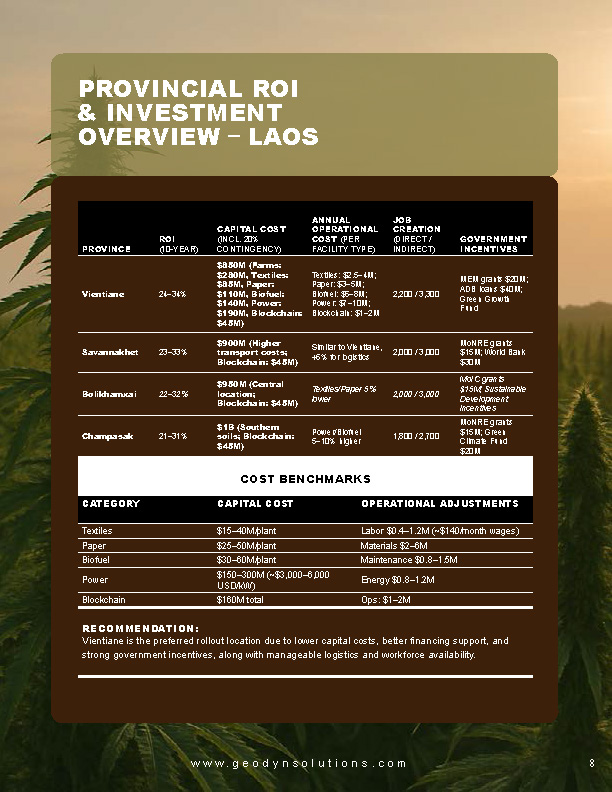
| Province | ROI (10-Year Estimate) | Capital Cost (Total, incl. 20% Contingency, USD) | Operational Cost (Annual, Per Facility Type, USD) | Job Creation (Direct/Indirect) | Government Incentives |
|---|---|---|---|---|---|
| Vientiane | 24-34% | $850M (farms: $280M, textiles: $85M, paper: $110M, biofuel: $140M, power: $190M, blockchain: $45M) | Textiles: $2.5-4M, Paper: $3-5M, Biofuel: $5-8M, Power: $7-10M, Blockchain: $1-2M | 2,200 / 3,300 | MEM grants $20M; ADB loans $40M; Green Growth Fund. |
| Savannakhet | 23-33% | $900M (higher transport; blockchain: $45M) | Similar to Vientiane, +5% logistics | 2,000 / 3,000 | MoNRE grants $15M; World Bank $30M. |
| Bolikhamxai | 22-32% | $950M (central location; blockchain: $45M) | Textiles/Paper 5% lower | 2,000 / 3,000 | MoIC grants $15M; Sustainable Development incentives. |
| Champasak | 21-31% | $1B (southern soils; blockchain: $45M) | Power/Biofuel 5-10% higher | 1,800 / 2,700 | MoNRE grants $15M; Green Climate Fund $20M. |
Capital costs similar, operational adjusted for $140/month labor. Vientiane recommended for rollout.
Investment Breakdown and Financial Projections
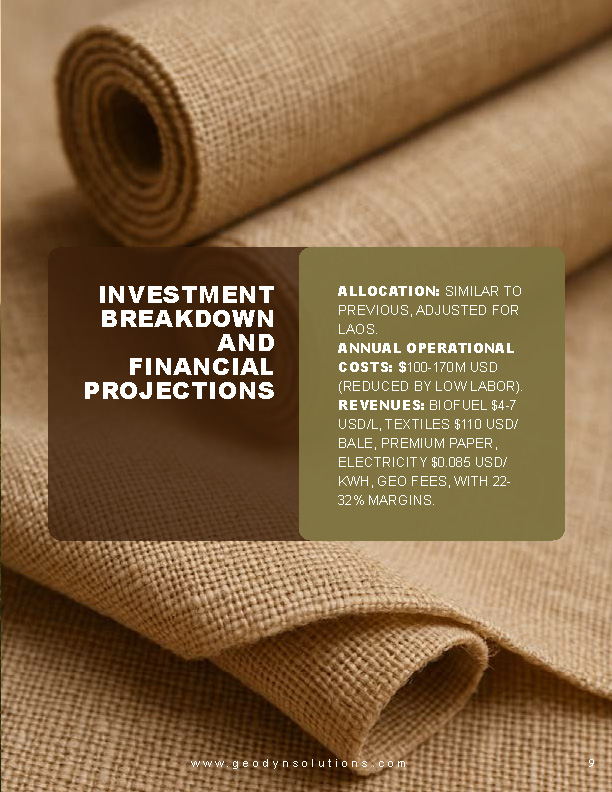
Allocation: Similar to previous, adjusted for Laos.
Annual operational costs: $100-170M USD (reduced by low labor). Revenues: Biofuel $4-7 USD/L, textiles $110 USD/bale, premium paper, electricity $0.085 USD/kWh, GEO fees, with 22-32% margins.
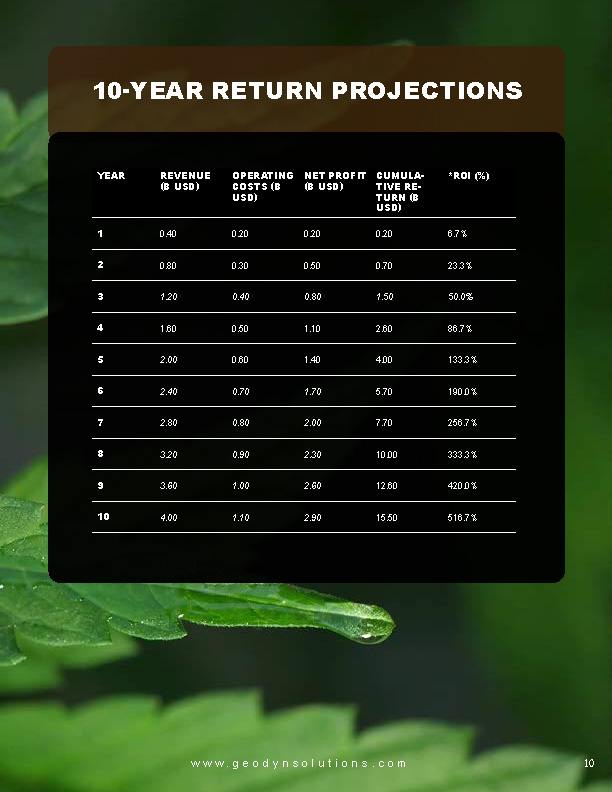
10-Year Return Chart
| Year | Revenue ($B USD) | Op Costs ($B USD) | Net Profit ($B USD) | Cumulative Return ($B USD) | ROI (%) |
|---|---|---|---|---|---|
| 1 | 0.4 | 0.2 | 0.2 | 0.2 | 6.7 |
| 2 | 0.8 | 0.3 | 0.5 | 0.7 | 23.3 |
| 3 | 1.2 | 0.4 | 0.8 | 1.5 | 50.0 |
| 4 | 1.6 | 0.5 | 1.1 | 2.6 | 86.7 |
| 5 | 2.0 | 0.6 | 1.4 | 4.0 | 133.3 |
| 6 | 2.4 | 0.7 | 1.7 | 5.7 | 190.0 |
| 7 | 2.8 | 0.8 | 2.0 | 7.7 | 256.7 |
| 8 | 3.2 | 0.9 | 2.3 | 10.0 | 333.3 |
| 9 | 3.6 | 1.0 | 2.6 | 12.6 | 420.0 |
| 10 | 4.0 | 1.1 | 2.9 | 15.5 | 516.7 |
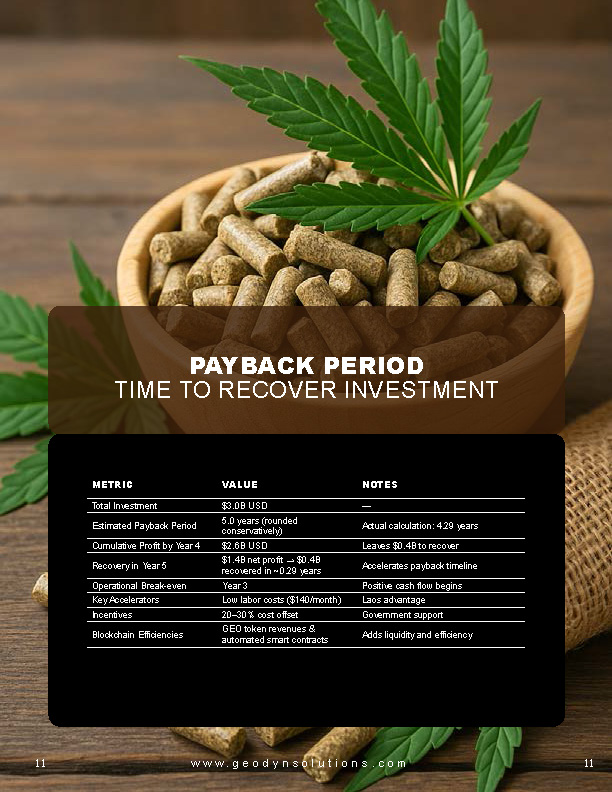
Payback Period: Time to Recover Investment
The payback period is estimated at 5.0 years. By year 4, cumulative profits reach $2.6 billion USD, leaving $0.4 billion to recover. In year 5, with $1.4 billion in net profit, recovery occurs after approximately 0.29 years (0.4 / 1.4), totaling 4.29 years (rounded to 5.0 for conservatism). Laos’ low labor costs ($140/month) and incentives (20-30% cost offset) accelerate this, as does blockchain-driven revenue. Operational break-even occurs in year 3.
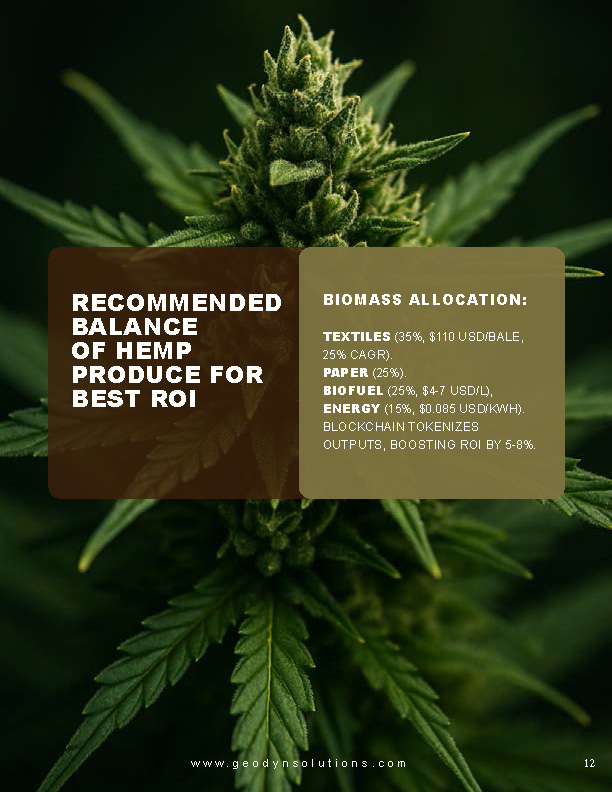
Recommended Balance of Hemp Produce for Best ROI
Biomass allocation: textiles (35%, $110 USD/bale, 25% CAGR), paper (25%), biofuel (25%, $4-7 USD/L), energy (15%, $0.085 USD/kWh). Blockchain tokenizes outputs, boosting ROI by 5-8%.
Economic Value to Laos
The project expands Laos’ hemp industry, contributing to $17-18B GDP. By 2030, it could add $5 billion in investments, 40,000 jobs, and $15 billion in output.
- Job Creation: 8,000 direct, 12,000 indirect, revitalizing rural areas.
- GDP Contribution: $3-5 billion USD/year by year five, plus $500-1B taxes.
- Broader Impacts: Reduces imports, enhances energy security, grows bioeconomy (0.1-0.2% GDP boost).
Additional Uses of Hemp to Minimize Waste and Enhance ROI
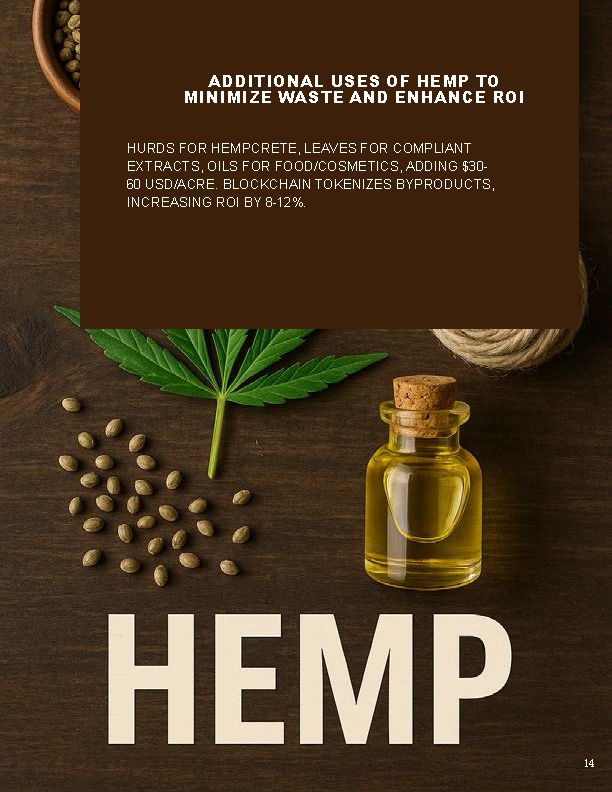
Hurds for hempcrete, leaves for compliant extracts, oils for food/cosmetics, adding $30-60 USD/acre. Blockchain tokenizes byproducts, increasing ROI by 8-12%.
Environmental Benefits
Hemp sequesters 10-15 tons CO2/acre, regenerates soil, cuts emissions 85-97%. Blockchain tracks for GEO credits. Offsets 1.5 million tons CO2/year, conserves water, enhances biodiversity.
Funding Sources and Incentives
Secure $300M+ USD: MEM grants ($20M), MoNRE ($15M), ADB loans ($40M), World Bank ($30M), Green Climate Fund ($20M). Offsets 20-30% of costs.
Risk Assessment and Mitigation
Risks: regulatory shifts (compliance teams, blockchain audits), market volatility (diversification), climate (multi-province). Mitigate with insurance, contracts.
Conclusion
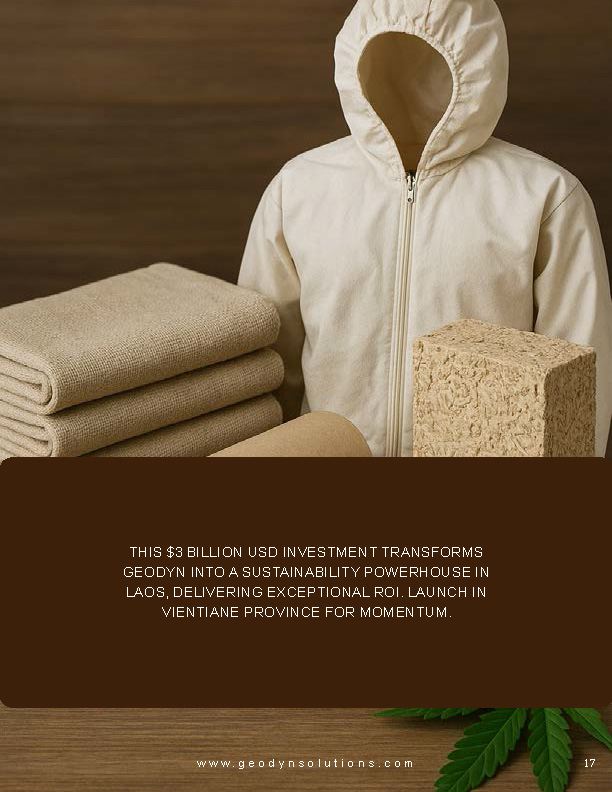
This $3 billion USD investment transforms Geodyn into a sustainability powerhouse in Laos, delivering exceptional ROI. Launch in Vientiane Province for momentum.
© 2025 Geodyn Solutions. All rights reserved.