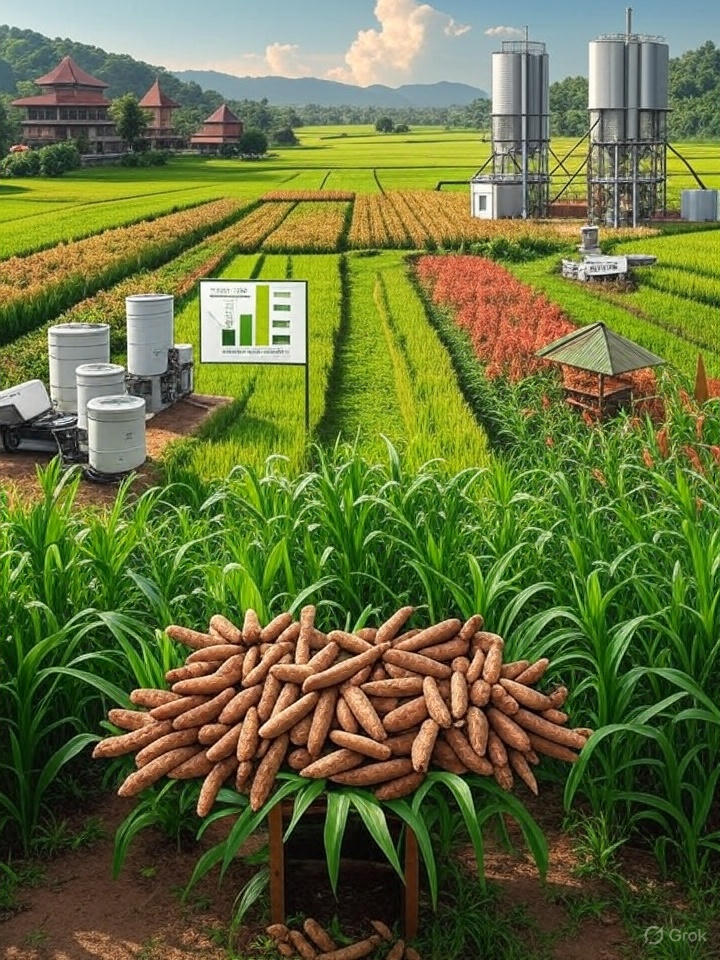
This proposal outlines a transformative initiative led by MicrobeBio, a leading microbial technology company specializing in organic agricultural solutions, in close collaboration with Geodyn Solutions—a pioneer in waste-to-energy, bio-fertilizer production, and sustainable waste management—and its strategic partners, including local governments, international organizations, technology providers, financial institutions, and academic institutions such as the National University of Laos (NUOL). The project aims to cultivate premium rice, cassava, and red corn on 400,000 hectares across Laos’s key agricultural regions, using MicrobeBio’s proprietary green microbial solutions integrated with cutting-edge technologies such as AI, blockchain, drones, satellites, robotics, and predictive analytics. A key focus is reclaiming and remediating toxic and salt-affected lands—prevalent due to salinity intrusion and pollution—transforming them into productive, usable farmland through microbial bioremediation and bio-fertilizer applications from Geodyn Solutions. To advance and improve irrigation, the project will implement state-of-the-art systems like enhanced Alternate Wetting and Drying (AWD) and System of Rice Intensification (SRI), integrated with solar-powered and AI-optimized infrastructure for water efficiency. Flood mitigation will be achieved through the creation of robust protection systems, including dikes, flood walls, and hybrid mangrove-reinforced barriers, drawing from successful models like the World Bank-funded Mekong Delta resilience projects. These measures will improve arable land by expanding growable areas, reducing flood risks, and enhancing soil resilience. Leveraging the Lao government’s incentives, including long-term land concessions offering leases up to 99 years for sustainable agricultural investments (with a proposed 50-year low-land lease to propel the project), this initiative will provide subsidized, long-term land access to attract investment and promote high-tech farming. The goal is to achieve 100% organic production with crop rotation for optimal yields, biodiversity, and food security, enhancing crop quality, yield, and sustainability while generating significant economic, environmental, and social benefits, including substantial CO2 reduction for improved ROI through carbon credits and emissions savings.
 Key elements include:
– Deployment of proprietary microbial biofertilizers, biopesticides, and soil amendments for organic farming, enhanced by Geodyn’s waste-derived bio-products.
– Integration of the latest global advanced technologies for precision agriculture, including predictive pre-planting models to mitigate weather-related losses, satellite and drone monitoring, 24-hour automated robotic tractors and combines, and IoT sensors.
– Crop rotation: Alternating premium rice, cassava, and red corn to optimize yields, soil health, and biodiversity, with recommended land allocations of 50% rice, 30% cassava, and 20% red corn for balanced diversity, yield maximization, and quality enhancement based on Lao soil and climate conditions.
– Advanced irrigation improvements: Upgrading to low-water, AI-driven systems like SRI and AWD for 20-30% water savings and higher yields.
– Flood protection: Constructing dikes, walls, and hybrid systems with mangroves to mitigate flooding and protect farmland.
– Land improvement: Reclaiming 80,000 hectares of salt-affected and toxic lands, expanding growable areas through remediation and protection.
– Collaboration with local universities like NUOL to tap into regional talent for research, development, and employee training programs.
– Construction of state-of-the-art rice mills, research labs, seed development centers, and silos with a 5 million-ton storage capacity to enhance processing and ROI, with rice mills specifically designed to support premium rice production and value addition for cassava/red corn by-products.
– Projected 20-year ROI exceeding 4x initial investment, with break-even in year 5, bolstered by CO2 reductions enabling carbon credit revenues of $8-20 million annually and government land lease incentives reducing CAPEX by 10-20%.
– Creation of over 240,000 jobs, with wages aligned to Laos’s average agricultural salary of approximately $2,000 per year, improved food security, and environmental restoration.
– Pursuit of incentives and grants from sources like the Ministry of Planning and Investment (MPI) and international bodies to offset costs.
– Establishment of an enviable green model that positions the project as a global benchmark for sustainable agriculture, elevating crop quality to the top of the world—aiming for top honors and awards such as IRRI Excellence Awards and World Rice Conference recognitions—with the ultimate goal of making Laos a top producer in both volume and quality worldwide.
The project aligns with Laos’s sustainable development goals, targeting 100% organic crops for human and animal health, improved nutrient profiles, flavor, and Brix levels (sugar content), while addressing climate challenges through innovative remediation, irrigation advancements, and flood mitigation.
Recommended locations: Mekong and Tonle Sap regions, focusing on provinces like Savannakhet (for rice, cassava, red corn), Champasak (for rice), Khammouane (for cassava), and Luang Prabang (for red corn), where fertile soils and existing infrastructure support high yields.
Introduction
MicrobeBio is a microbial technology company dedicated to developing 100% organic solutions for agriculture, including biofertilizers, biopesticides, and soil health enhancers that promote sustainable farming and enhance crop productivity. In collaboration with Geodyn Solutions, a leader in transforming waste into bio-fertilizers, energy, and sustainable agricultural inputs, and its strategic partners, this project leverages combined expertise to scale organic farming of premium rice, cassava, and red corn on 400,000 hectares—about 17% of Laos’s 2.3 million hectares of arable land. Geodyn Solutions brings proven technologies in waste recycling, insect farming for soil enhancement, and algae-based solutions, complementing MicrobeBio’s microbial innovations for land remediation and CO2 reduction. Laos, with its tropical climate and fertile Mekong and Tonle Sap regions, faces challenges like soil degradation, water scarcity, climate change, salinity intrusion affecting up to 1.8 million hectares, and toxic contamination from industrial runoff. To address these, the project will advance irrigation through modern, efficient systems; create flood protection walls and dikes integrated with natural barriers like mangroves; and improve arable land by reclaiming degraded areas and safeguarding them from floods. By reclaiming and remediating these lands using microbial and bio-fertilizer technologies, and capitalizing on the government’s long-term land concessions offering leases up to 99 years (with a proposed 50-year low-land lease to propel the project), the project will restore usability, reduce CO2 emissions through enhanced soil carbon sequestration and low-emission farming, and create an enviable green model that elevates Lao crops to world-class quality, positioning Laos as a top producer in production and excellence.
Partners may include AI firms (e.g., drone providers like XAG), blockchain platforms (e.g., for traceability), Lao agricultural ministries, international bodies like the International Rice Research Institute (IRRI), and local universities such as NUOL for talent development and training. The project supports Laos’s agricultural policies, which have shown profit increases in pilots, and draws from proven models like IRRI’s low-emission initiatives.
Objectives
– Achieve 100% organic production of premium rice, cassava, and red corn on 400,000 hectares, eliminating chemical inputs for better human and animal health.
– Implement crop rotation (e.g., rice-cassava-red corn cycles) for optimal yields, soil health, biodiversity, and food security, with recommended allocations of 50% rice, 30% cassava, and 20% red corn to balance diversity, maximize yields (e.g., rice for wet seasons, cassava/red corn for dry), and enhance quality through nutrient cycling and pest reduction.
– Advance and improve irrigation systems to optimize water use, reduce scarcity, and enhance crop resilience.
– Create flood protection systems, including dikes and walls, to mitigate flooding and safeguard farmland.
– Improve arable land through reclamation, remediation, and protection measures to expand productive areas.
– Reclaim and remediate toxic and salt-affected lands to expand usable farmland, using microbial solutions to restore soil fertility and reduce salinity.
– Integrate advanced AI and technologies to optimize yields, reduce waste, and improve crop quality (e.g., higher nutrients, flavor, and Brix levels of 10-12° for premium rice), aiming to elevate it to the top of global standards with awards and honors.
– Enhance ROI through AI-driven efficiencies, blockchain-enabled supply chains, token-based incentives, and CO2 reductions via carbon sequestration and credits, propelled by the government’s 50-year low-land lease incentive for cost-effective scaling.
– Create infrastructure including rice mills, labs, seed R&D centers, and 5 million-ton silos to support the project and neighboring areas, with rice mills optimized for premium rice processing and value addition to cassava/red corn by-products.
– Deliver economic benefits (e.g., job creation, ROI), environmental gains (e.g., soil regeneration, CO2 mitigation), and food security for Laos and exports, establishing an enviable green model.
– Collaborate with local universities like NUOL to leverage regional talent for innovation, research, and skilled workforce training.
– Position Laos as a top global producer in crop volume and quality, targeting top international awards.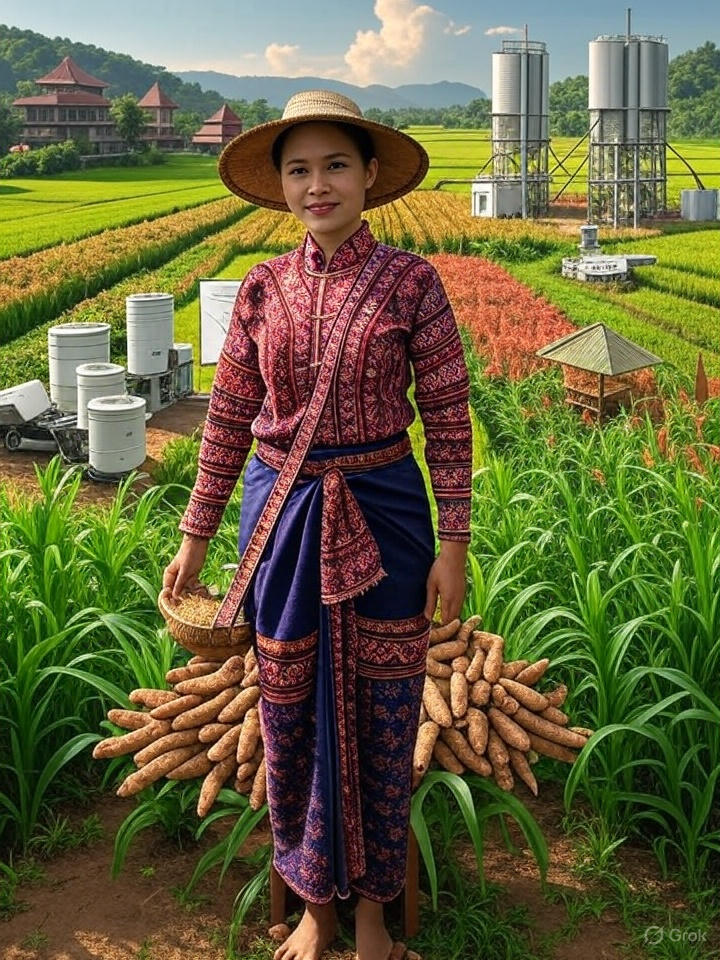
Project Scope and Area Requirements
The project targets 400,000 hectares in Laos’s Mekong and Tonle Sap regions, focusing on provinces like Savannakhet (rice, cassava, red corn), Champasak (rice), Khammouane (cassava), and Luang Prabang (red corn), where yields average 4-6 tons/ha for rice, 20-30 tons/ha for cassava, and 5-7 tons/ha for red corn. This includes reclaiming 80,000 hectares of salt-affected and toxic lands through bioremediation. With crop rotation (e.g., rice in wet season, cassava/red corn in dry), the area will produce approximately 2.4 million tons of premium rice, 8 million tons of cassava, and 2 million tons of red corn annually. Recommended crop allocations: 50% (200,000 ha) to rice for staple food security and high-value exports; 30% (120,000 ha) to cassava for industrial uses (e.g., starch, ethanol) and soil regeneration; 20% (80,000 ha) to red corn for animal feed and diversification, optimizing diversity by preventing monoculture risks, improving soil nutrients (cassava/red corn fix nitrogen for rice), and enhancing yields by 10-15% through rotation. Additional land (20,000 hectares) will be allocated for infrastructure: 8,000 ha for mills and silos, 4,000 ha for labs and R&D, and 8,000 ha for buffer zones and integrated farming. Total land footprint: 420,000 hectares. The government’s 50-year low-land lease incentive will enable secure, affordable access to this land, with reduced rental fees for sustainable initiatives, accelerating project rollout and minimizing financial barriers.
Technologies and Solutions for Quality Improvement and Sustainability
To make the project fully green and enhance crop quality (e.g., nutrient density, flavor via microbial enhancements, and Brix via optimized photosynthesis), aiming for world-topping excellence, the following comprehensive list of the latest advanced technologies will be deployed. These draw from proven global models, such as IRRI’s smart farming applications in Asia, XAG’s drone programs in Laos, and data-driven sustainable crop intensification, which have demonstrated yield increases of 8-20%, input reductions of 10-30%, and emission cuts of 30-70%. Integration will be supported by collaborations with local universities like NUOL to adapt technologies, conduct joint R&D, tap into local talent, and provide training programs for skilled employees, ensuring knowledge transfer and workforce development.
Proprietary Green Solutions and Remediation
– MicrobeBio’s microbial products, enhanced by Geodyn Solutions’ bio-fertilizers: Biofertilizers and biopesticides to boost soil microbes, increasing nutrient uptake, yield by 10-20%, and crop resilience. These enable 100% organic certification, improving flavor and nutrients (e.g., higher vitamins and antioxidants), while remediating toxic and salt-affected soils by breaking down contaminants and reducing salinity through microbial desalination and organic matter addition.
– Waste-to-bio solutions from Geodyn: Transforming organic waste into bio-fertilizers and energy, supporting land reclamation and CO2 reduction by avoiding landfill emissions.
Advanced Irrigation Improvements
– Enhanced AWD and SRI systems: Upgrading irrigation with AI-monitored AWD for intermittent flooding, reducing water use by 20-30% and methane emissions, combined with SRI for 70-90% less seed and pesticides, as proven in Lao low-emission pilots.
– Solar-powered and drip irrigation: Integrating solar energy for pumps and drip systems adapted for crops, promoting water conservation and yield increases, as in Lao models.
– Integrated crop systems: Diversified farming with improved irrigation for rotation, enhancing water efficiency and profitability.
Flood Protection Systems
– Dikes and flood walls: Constructing reinforced dikes and walls along vulnerable areas, similar to Mekong resilience projects, to prevent chronic flooding and salinity intrusion.
– Hybrid mangrove barriers: Integrating mangroves with engineered structures for ecosystem-based protection, providing superior flood defense and co-benefits like biodiversity, as in Lao coastal models.
– Retrofitted dams and sluice gates: Upgrading existing infrastructure to restore natural flood regimes while controlling water flow, aligning with Laos’s sustainable delta plan.
AI and Predictive Analytics
– AI-powered predictive pre-planting models: Using machine learning to analyze data for optimal planting times, varieties, and risk mitigation against floods or droughts, reducing losses by 15-25%.
– Yield estimation and disease prediction: AI systems for real-time monitoring of growth, pests, and quality metrics, enhancing growth by 10-15% to achieve award-winning quality.
 Satellite and Remote Sensing
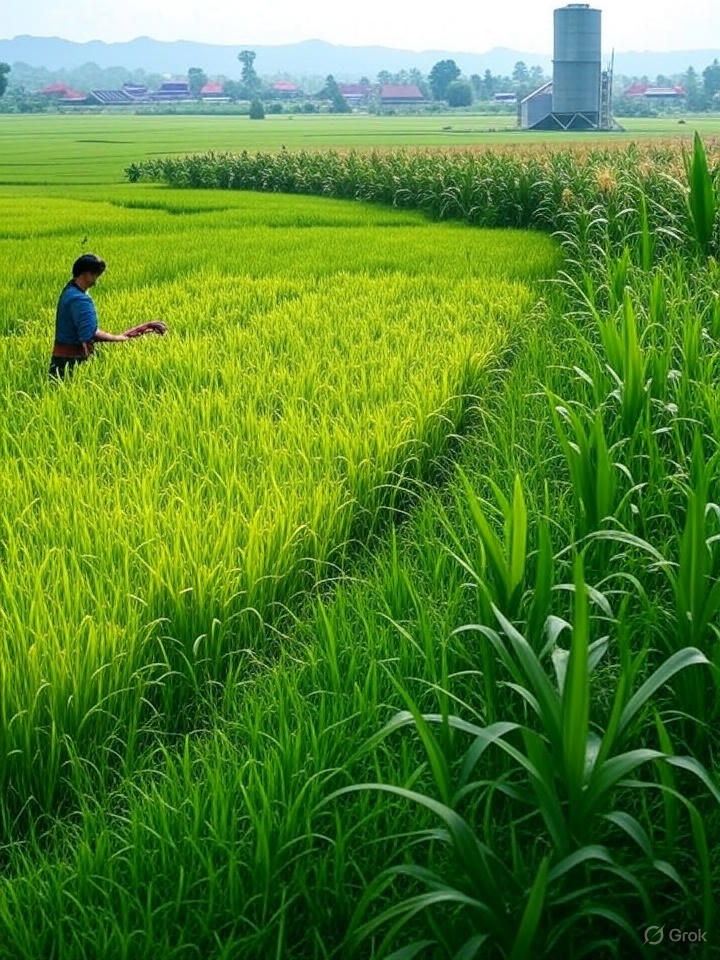
– Satellite imagery: Utilizing high-resolution data for crop health mapping, soil moisture analysis, and field classification, enabling precise resource allocation and yield forecasting.
Drones and Aerial Technologies
– Multispectral drones: AI-equipped drones for targeted spraying, pest detection, and fertilizer application, reducing chemical use by 20-30%.
Robotics and Automation
– 24-hour automated robotic tractors and combines: Autonomous systems for planting, weeding, and harvesting, minimizing soil compaction and labor costs.
– Smart robotics for weeding and monitoring: Machine learning-based robots for weed plucking and crop inspection.
IoT and Smart Systems
– IoT sensors: For smart irrigation, saving 20-30% water and cutting emissions by 30-70%.
– Integrated platforms: Combining IoT with AI for variable-rate nutrient applications.
Blockchain and Tokens
– Supply chain traceability: Blockchain for transparent tracking from farm to export, ensuring organic integrity and premium pricing.
– Token system: Utility tokens for farmer incentives, carbon credits, and ROI sharing.
Additional Green and Proven Technologies
– Crop rotation: Rice-cassava-red corn cycles to maintain soil fertility, biodiversity, and yields, preventing depletion, with 50% rice, 30% cassava, and 20% red corn allocations to ensure diversity (rice for high-value exports and food security, cassava/red corn for soil recovery and feed/industrial uses).
– Regenerative practices: Integrated systems for biodiversity and income diversification.
– Solar-powered irrigation and eco-friendly pest control: Innovations for higher yields.
CO2 Reduction Technologies
– AWD: Reducing methane emissions by 30-70%, with reductions of 3-12 tons CO2e/ha/crop.
– Microbial-enhanced soil sequestration: Promoting carbon storage, adding 1-2 tons CO2e/ha/year.
– Waste-to-energy: Avoiding 0.5-1 ton CO2e/ha emissions.
– Precision nutrient management: Cutting nitrous oxide by 20-30%.
– Overall: Targeting 40-50% reduction from baseline, equating to 0.8-1.6 million tons CO2e reduced annually across 400,000 ha.
University collaborations will include joint labs at NUOL for technology testing, talent recruitment, and training, fostering 2,000+ skilled jobs annually.
Infrastructure
– Advanced rice mills: Automated with AI sorting (capacity: 2.4 million tons/year), costing ~$120 million, specifically designed to process premium rice and support value addition for cassava (e.g., starch extraction) and red corn (e.g., feed milling), enhancing overall ROI through integrated processing for all crops.
– Labs and seed R&D: For microbial testing and hybrid seed development, budgeted at $80 million.
– Silos: 5 million-ton capacity for storage, supporting project and neighbors, at ~$500 million (assuming $100/ton construction cost).
– Irrigation and flood protection: Upgraded systems, budgeted at $200 million.
Implementation Plan
– Phase 1 (Years 1-2): Land acquisition using 50-year leases; infrastructure build-out including irrigation, flood walls, and rice mills; remediation pilots on 40,000 ha with initial tech and training.
– Phase 2 (Years 3-5): Scale to full 400,000 ha, full tech rollout, organic certification, crop rotation implementation, and NUOL collaborations.
– Phase 3 (Years 6+): Optimization, export expansion, token maturity, ongoing training, and pursuit of awards.

Financial Analysis
CAPEX
Total CAPEX: $1.104 billion (original $0.92 billion plus 20% contingency for risks), phased: $552 million/year for Years 1-2, reduced by government 50-year low-land lease incentives providing subsidized rates. Breakdown:
– Infrastructure (mills, silos, labs): $840 million (mills: $120M; silos: $500M; labs/R&D: $80M; plus 20% contingency: $140M).
– Technology integration: $120 million (plus 20% contingency: $24M).
– Irrigation advancements and flood protection systems: $200 million (plus 20% contingency: $40M).
– Land remediation and initial microbial applications: $40 million (plus 20% contingency: $8M).
– University collaborations and training setups: $20 million (plus 20% contingency: $4M).
– Miscellaneous (planning, permits): $20 million (plus 20% contingency: $4M).
– Land lease costs: Subsidized under 50-year incentive, reducing effective CAPEX by $80 million.
Funding through grants, investments, and green bonds.
OPEX
Annual OPEX at full scale: $1.4 billion. Breakdown (farming ~$3,500/ha/year for 400,000 ha = $1.4B; processing 10% of revenue):
– Labor: $600 million (200,000 farming jobs at $2,000/year = $400M; 40,000 processing/R&D at $3,000/year = $120M).
– Inputs: $320 million.
– Operations (maintenance, tech): $240 million.
– Processing: $168 million.
– Remediation ongoing: $40 million.
– Land lease ongoing: Low rates under 50-year incentive, ~$100/ha/year subsidized.
Revenue and ROI
– Annual revenue: $1.68 billion (2.4M tons rice at $700/ton, 8M tons cassava at $200/ton, 2M tons red corn at $250/ton), plus $8-20 million from carbon credits (0.8-1.6M tons CO2e at $5-10/ton).
– Annual profit: $280 million (growing 2%/year post-Year 5).
– Return on Investment: Break-even in Year 5; positive from Year 3; full return by Year 7.
20-Year ROI Chart
| Year | CAPEX ($) | OPEX ($) | Revenue ($) | Cash Flow ($) | Cumulative Cash Flow ($) | ROI (%) |
|---|---|---|---|---|---|---|
| 1 | 552,000,000 | 0 | 0 | -552,000,000 | -552,000,000 | -50 |
| 2 | 552,000,000 | 0 | 0 | -552,000,000 | -1,104,000,000 | -100 |
| 3 | 0 | 700,000,000 | 840,000,000 | 140,000,000 | -964,000,000 | -87 |
| 4 | 0 | 1,050,000,000 | 1,260,000,000 | 210,000,000 | -754,000,000 | -68 |
| 5 | 0 | 1,400,000,000 | 1,680,000,000 | 280,000,000 | -474,000,000 | -43 |
| 6 | 0 | 1,400,000,000 | 1,685,600,000 | 285,600,000 | -188,400,000 | -17 |
| 7 | 0 | 1,400,000,000 | 1,691,312,000 | 291,312,000 | 102,912,000 | 9 |
| 8 | 0 | 1,400,000,000 | 1,697,136,960 | 297,136,960 | 400,048,960 | 36 |
| 9 | 0 | 1,400,000,000 | 1,703,079,699 | 303,079,699 | 703,128,659 | 64 |
| 10 | 0 | 1,400,000,000 | 1,709,141,290 | 309,141,290 | 1,012,269,949 | 92 |
| 11 | 0 | 1,400,000,000 | 1,715,324,032 | 315,324,032 | 1,327,593,981 | 120 |
| 12 | 0 | 1,400,000,000 | 1,721,630,264 | 321,630,264 | 1,649,224,245 | 149 |
| 13 | 0 | 1,400,000,000 | 1,728,062,372 | 328,062,372 | 1,977,286,617 | 179 |
| 14 | 0 | 1,400,000,000 | 1,734,622,787 | 334,622,787 | 2,311,909,404 | 209 |
| 15 | 0 | 1,400,000,000 | 1,741,313,982 | 341,313,982 | 2,653,223,386 | 240 |
| 16 | 0 | 1,400,000,000 | 1,748,138,470 | 348,138,470 | 3,001,361,856 | 272 |
| 17 | 0 | 1,400,000,000 | 1,755,098,808 | 355,098,808 | 3,356,460,664 | 304 |
| 18 | 0 | 1,400,000,000 | 1,762,197,600 | 362,197,600 | 3,718,658,264 | 337 |
| 19 | 0 | 1,400,000,000 | 1,769,437,483 | 369,437,483 | 4,088,095,747 | 370 |
| 20 | 0 | 1,400,000,000 | 1,776,821,145 | 376,821,145 | 4,464,916,892 | 405 |