Proposal to Maximize Cambodia’s Hydropower Capacity with Green Technologies and Digital Innovation
Executive Vision
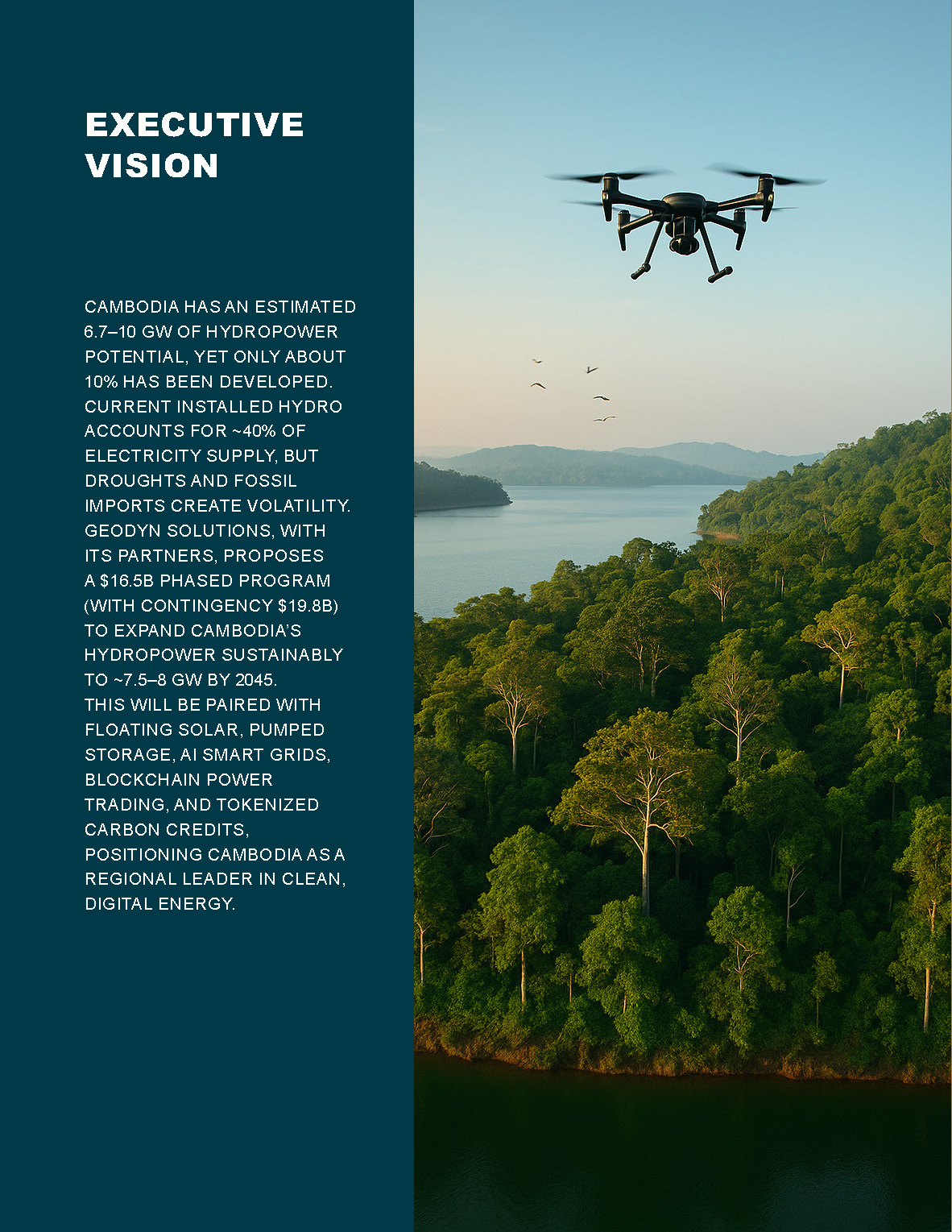
Cambodia has an estimated 6.7–10 GW of hydropower potential, yet only about 10% has been developed. Current installed hydro accounts for ~40% of electricity supply, but droughts and fossil imports create volatility. Geodyn Solutions, with its partners, proposes a $16.5B phased program (with contingency $19.8B) to expand Cambodia’s hydropower sustainably to ~7.5–8 GW by 2045. This will be paired with floating solar, pumped storage, AI smart grids, blockchain power trading, and tokenized carbon credits, positioning Cambodia as a regional leader in clean, digital energy.
Project Scope & Phased Development
Phase I (2026–2032): Expand on Tributaries + Solar-Hydro Hybrids
-
Focus on tributary projects (Sesan, Srepok, Sekong basins, Cardamom range rivers).
-
Deploy floating solar-hydro hybrids on reservoirs to increase output and reduce evaporation.
-
Introduce AI-driven water flow prediction to stabilize dry-season production.
-
Strengthen the 230–500 kV grid to link hydro and solar into Phnom Penh and industrial zones.
Phase II (2032–2045): Storage + Digital Market Leadership
-
Build pumped-storage hydropower plants for peak load stability.
-
Integrate green hydrogen plants powered by surplus hydro for export and transport decarbonization.
-
Deploy blockchain-based smart contracts for transparent PPAs with Vietnam, Thailand, and Laos.
-
Launch a national carbon token system, enabling each kWh exported to be paired with digital carbon credits tradeable globally.
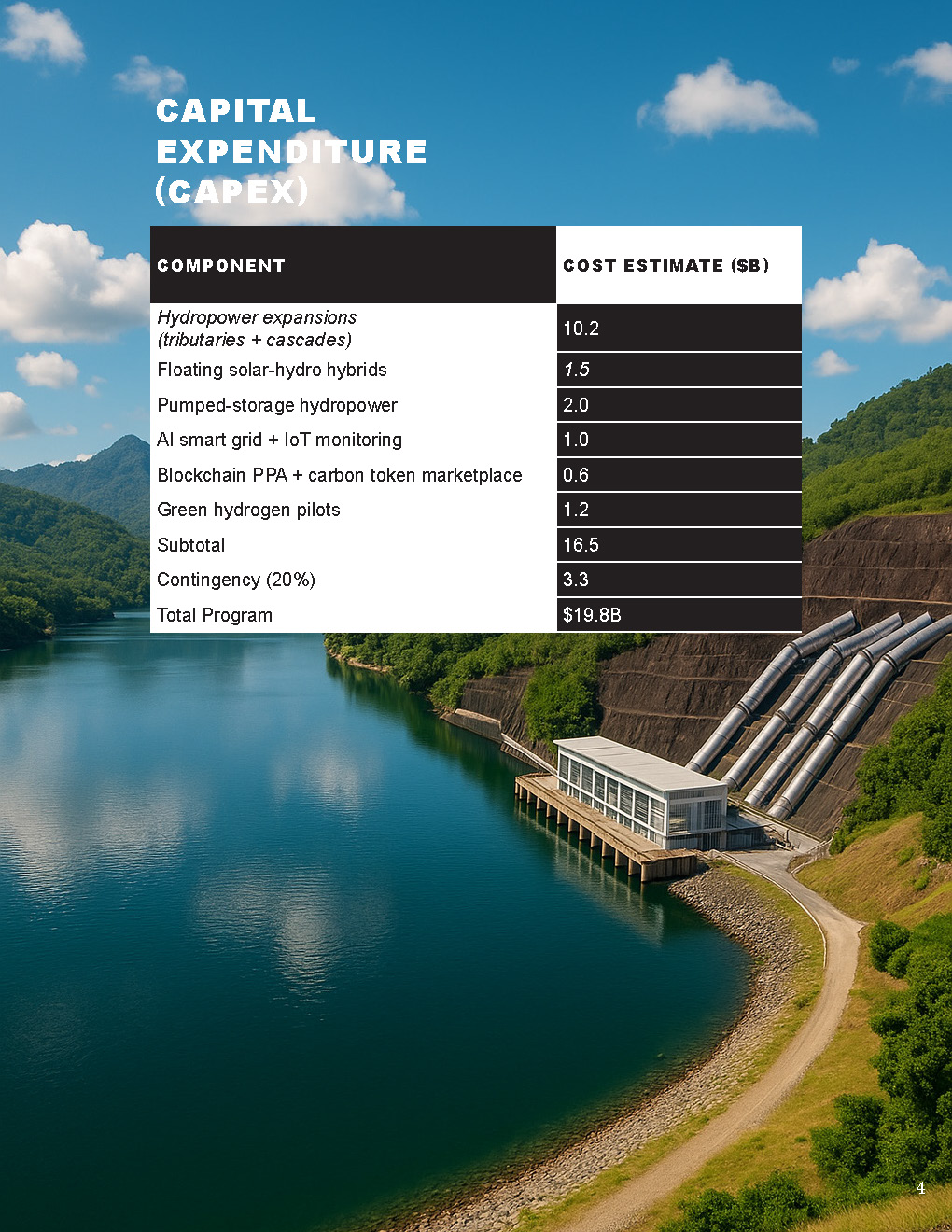
Capital Expenditure (CAPEX)
|
Component
|
Cost Estimate ($B)
|
|---|---|
|
Hydropower expansions (tributaries + cascades)
|
10.2
|
|
Floating solar-hydro hybrids
|
1.5
|
|
Pumped-storage hydropower
|
2.0
|
|
AI smart grid + IoT monitoring
|
1.0
|
|
Blockchain PPA + carbon token marketplace
|
0.6
|
|
Green hydrogen pilots
|
1.2
|
|
Subtotal
|
16.5
|
|
Contingency (20%)
|
3.3
|
|
Total Program
|
$19.8B
|
Operating Expenditure (OPEX)
-
Estimated at $380M annually, including O&M, grid balancing, AI systems, blockchain administration, and social-environmental programs.
Revenue & 20-Year ROI
Revenue Streams (by 2045)
-
Electricity sales & exports: ~$1.8B/year (domestic + cross-border PPAs with Thailand/Vietnam).
-
Carbon credits/tokenization: ~$250M/
year (at $25–30/ton CO₂ avoided). -
Green hydrogen exports: ~$150M/year starting 2035.
-
Floating solar integration services & microgrids: ~$100M/year.
-
Total potential annual revenue: ~$2.3B
20-Year ROI Projection
|
Year
|
Capacity (GW)
|
Cumulative Investment ($B)
|
Annual Revenue ($B)
|
Net Profit ($B)
|
Cumulative ROI (%)
|
|---|---|---|---|---|---|
|
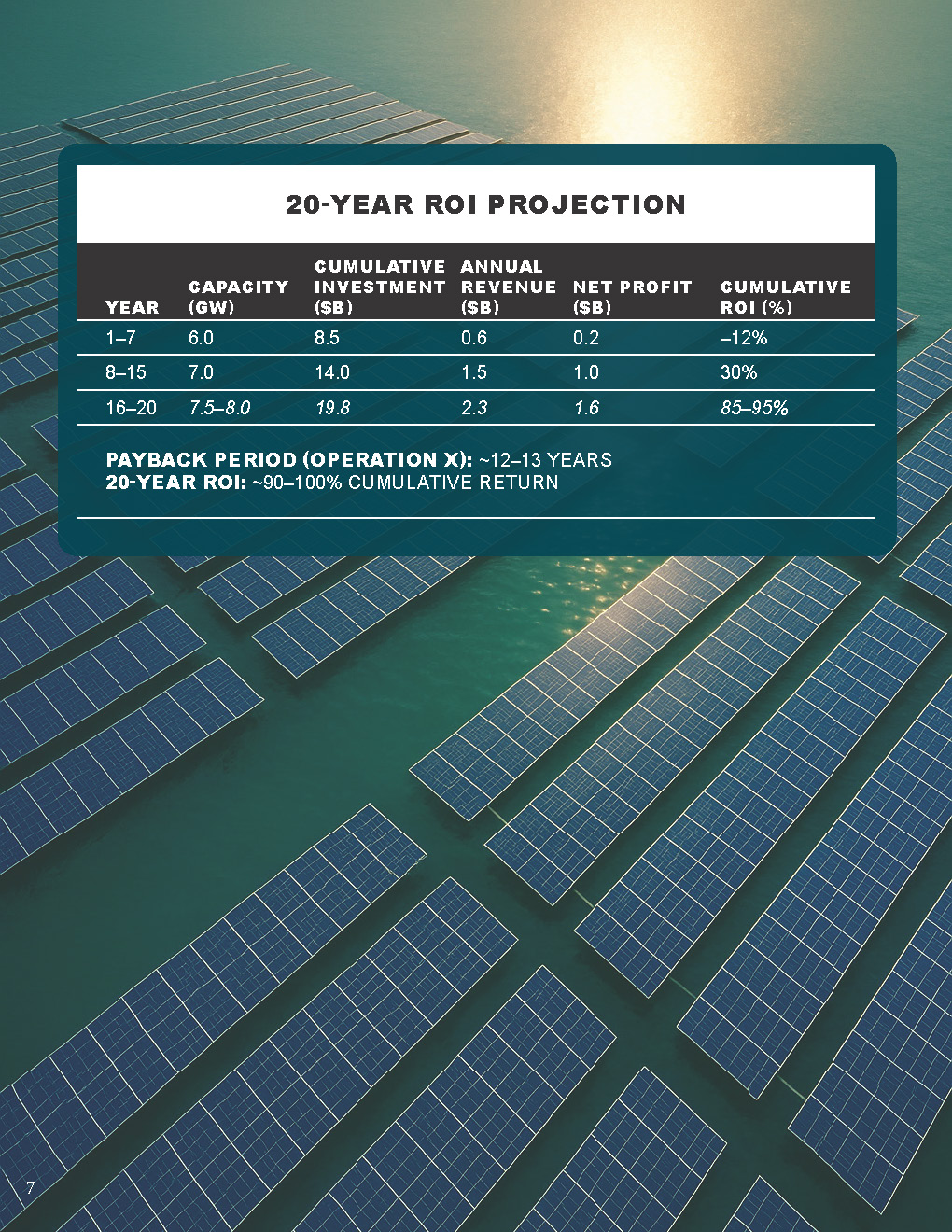
1–7
|
6.0
|
8.5
|
0.6
|
0.2
|
–12%
|
|
8–15
|
7.0
|
14.0
|
1.5
|
1.0
|
30%
|
|
16–20
|
7.5–8.0
|
19.8
|
2.3
|
1.6
|
85–95%
|
-
Payback Period (Operation X): ~12–13 years
-
20-Year ROI: ~90–100% cumulative return
Job Creation & Economic Benefits
-
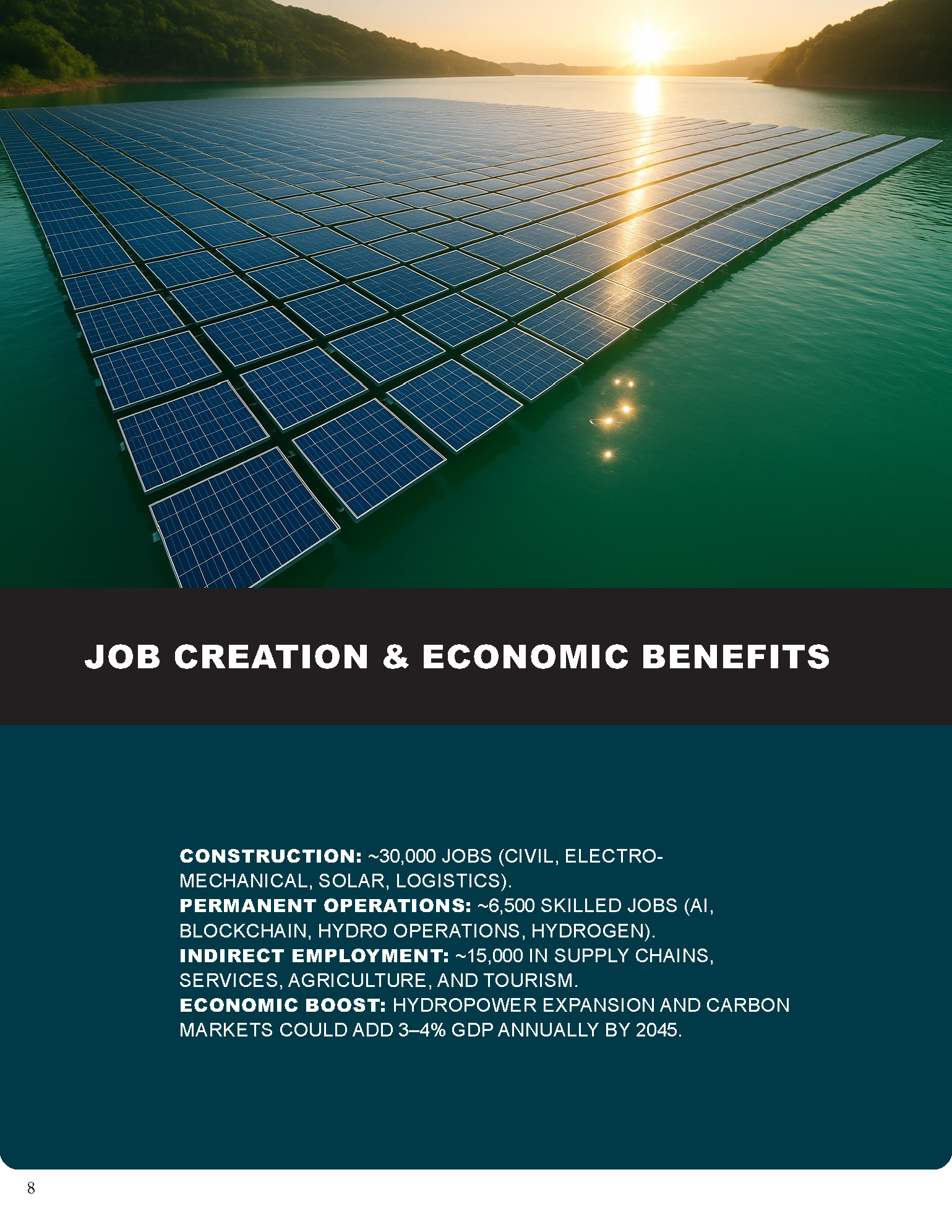
Construction: ~30,000 jobs (civil, electro-mechanical, solar, logistics).
-
Permanent Operations: ~6,500 skilled jobs (AI, blockchain, hydro operations, hydrogen).
-
Indirect Employment: ~15,000 in supply chains, services, agriculture, and tourism.
-
Economic Boost: Hydropower expansion and carbon markets could add 3–4% GDP annually by 2045.
Green Technologies Integration
-
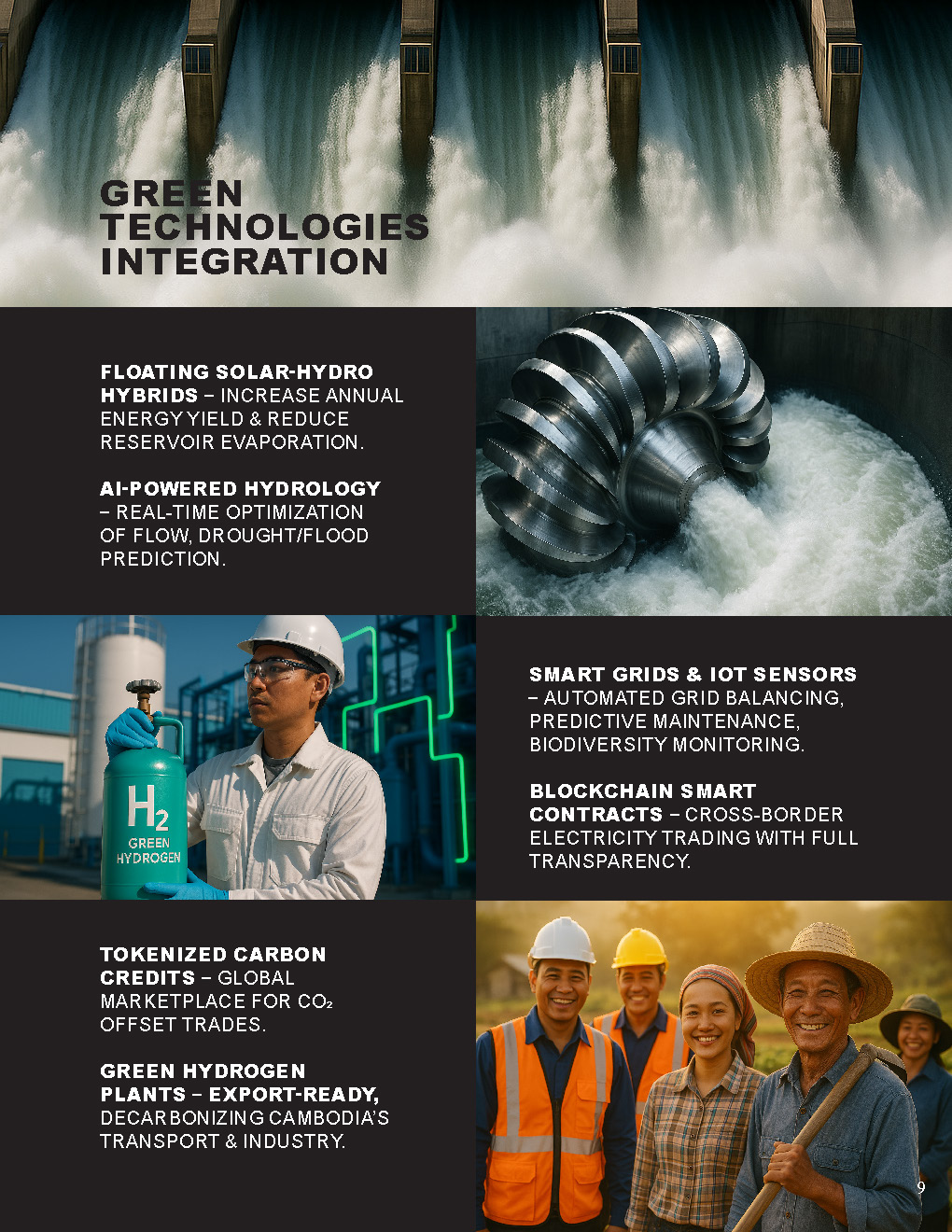
Floating Solar-Hydro Hybrids – increase annual energy yield & reduce reservoir evaporation.
-
AI-Powered Hydrology – real-time optimization of flow, drought/flood prediction.
-
Smart Grids & IoT Sensors – automated grid balancing, predictive maintenance, biodiversity monitoring.
-
Blockchain Smart Contracts – cross-border electricity trading with full transparency.
-
Tokenized Carbon Credits – global marketplace for CO₂ offset trades.
-
Green Hydrogen Plants – export-ready, decarbonizing Cambodia’s transport & industry.
-
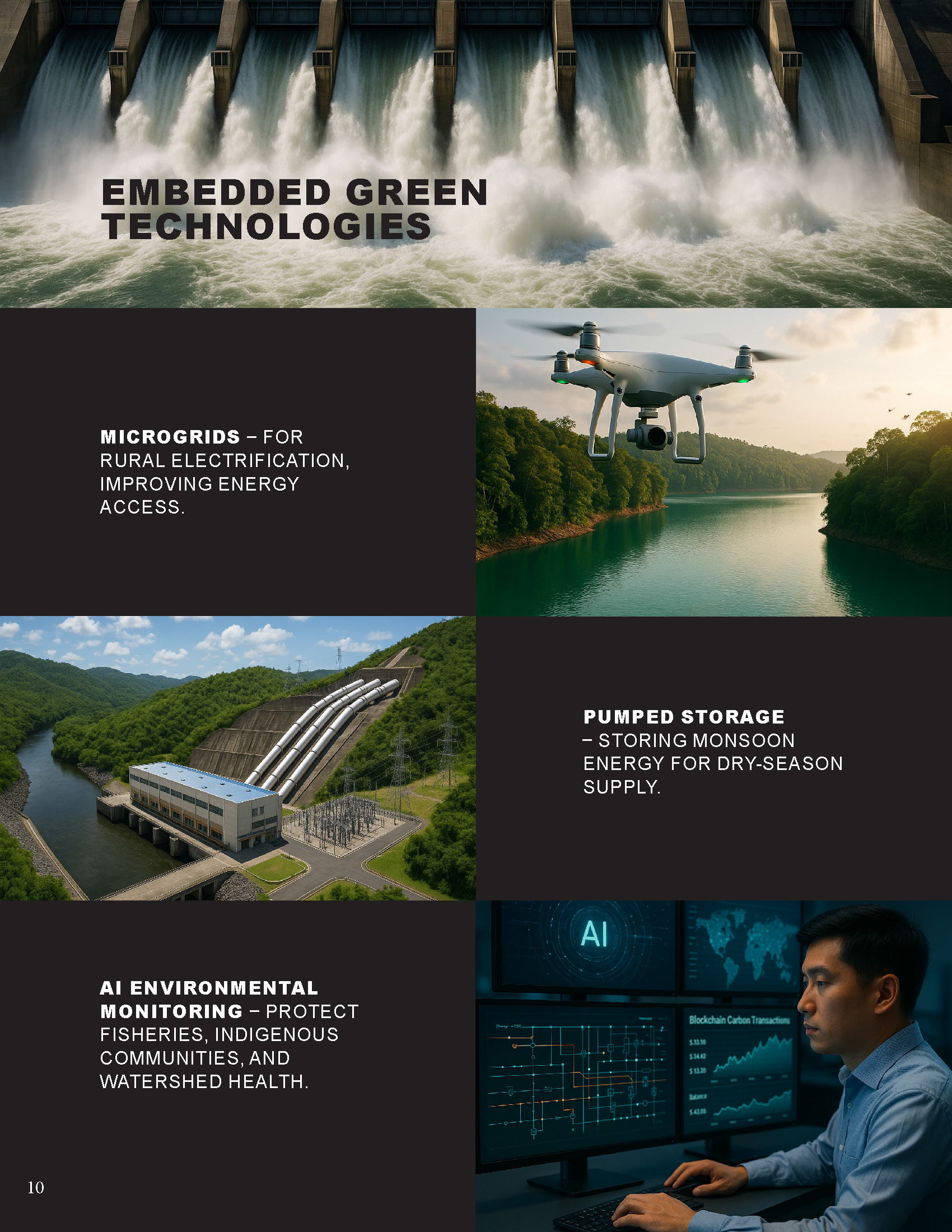
Microgrids – for rural electrification, improving energy access.
-
Pumped Storage – storing monsoon energy for dry-season supply.
-
AI Environmental Monitoring – protect fisheries, indigenous communities, and watershed health.
Environmental & Social Benefits
-
CO₂ reduction: ~12M tons annually by offsetting coal imports.
-
Energy equity: Community energy tokens to ensure rural households access affordable renewable power.
-
Sustainability: AI & IoT used to protect fisheries, forests, and indigenous livelihoods.
-
Climate resilience: Diversification with solar + hydro reduces drought vulnerability.
Strategic Benefits
-
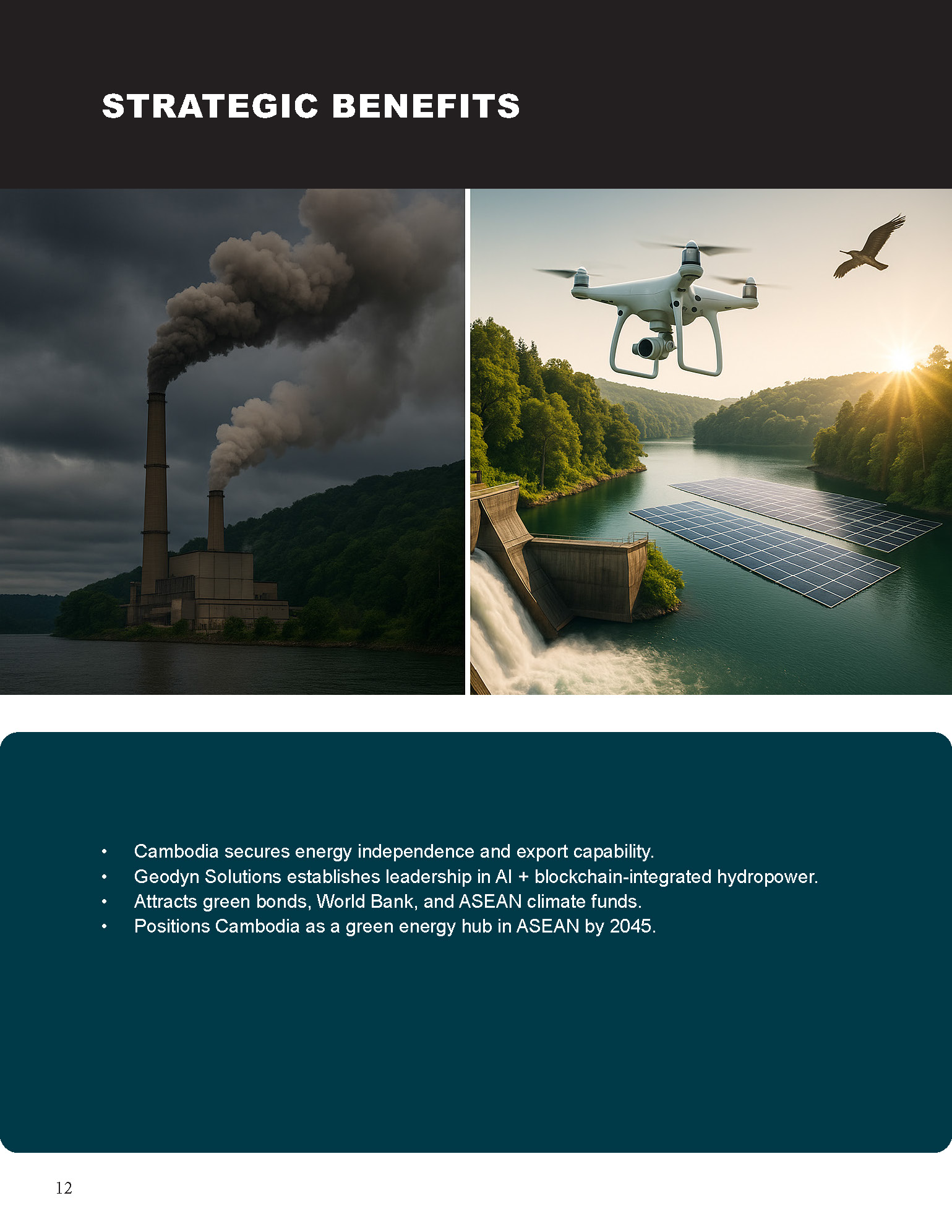
Cambodia secures energy independence and export capability.
-
Geodyn Solutions establishes leadership in AI + blockchain-integrated hydropower.
-
Attracts green bonds, World Bank, and ASEAN climate funds.
-
Positions Cambodia as a green energy hub in ASEAN by 2045.
Conclusion
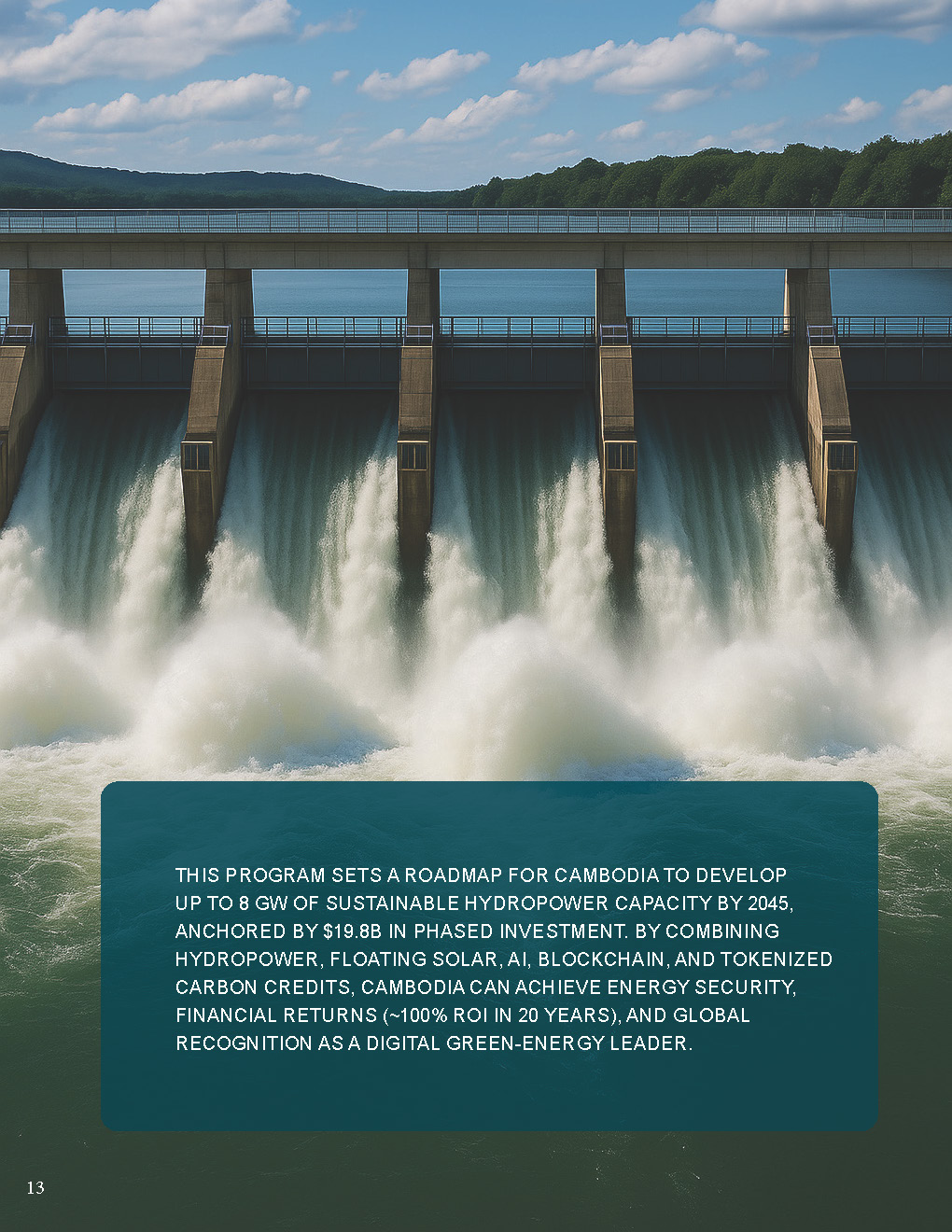
This program sets a roadmap for Cambodia to develop up to 8 GW of sustainable hydropower capacity by 2045, anchored by $19.8B in phased investment. By combining hydropower, floating solar, AI, blockchain, and tokenized carbon credits, Cambodia can achieve energy security, financial returns (~100% ROI in 20 years), and global recognition as a digital green-energy leader.